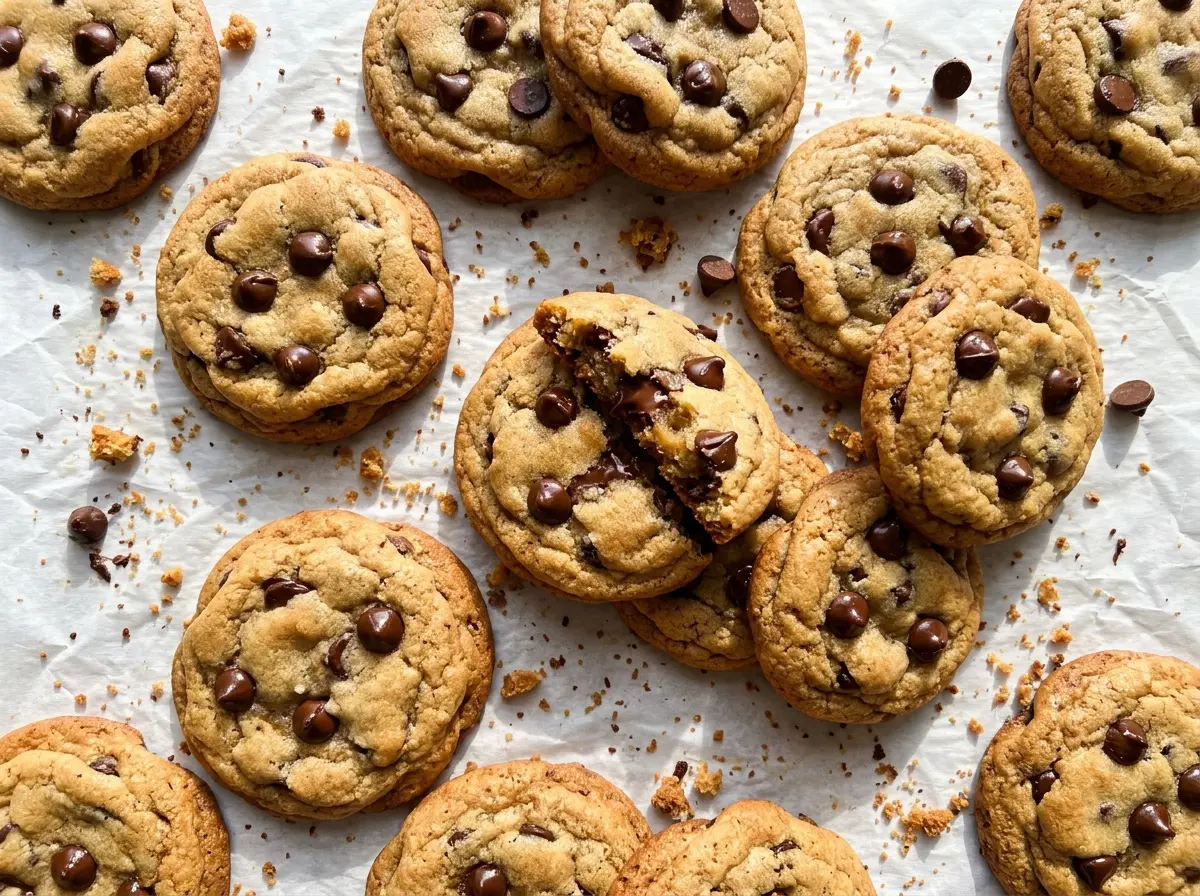
The brown sugar canister is empty, the oven is already on, and the cookie craving hasn’t gone anywhere. These chocolate chip cookies without brown sugar use granulated sugar instead, so you can still make a familiar tray of buttery cookies with semisweet chocolate in every bite. The edges bake to a light gold, and the centers stay tender.
Without molasses, the cookies taste cleaner and less caramel-like than the classic brown-sugar version. I like that difference here: vanilla and chocolate come through clearly, and the edges have a delicate crispness. They’re a good reminder that a missing ingredient doesn’t always mean you need a substitute.
Once cooled, each cookie has a crisp edge, a soft middle, and little pockets of chocolate that stay rich against the simple, buttery dough.
Kitchen Note
Spoon the flour into your measuring cup and level it off instead of scooping straight from the bag. A packed cup can leave the dough too stiff and the cookies dry, so this small measuring habit is worth the extra moment.
Save these chocolate chip cookies without brown sugar for the next time the pantry is missing an ingredient but you still want golden edges and soft, chocolate-filled centers.
Why Granulated Sugar Makes a Different Cookie, Not a Failed Brown-Sugar One
Brown sugar brings molasses along with its sweetness. That molasses adds a deeper, almost toffee-like flavor and moisture, so cookies made with it often have a chewier character. Granulated sugar has neither, and it’s better to let that difference be part of the cookie than to try to disguise it.
Here, granulated sugar gives the dough a clean sweetness that lets the butter, vanilla, and semisweet chocolate stand out. The cookies still have tender centers, but the edges turn lightly crisp and the overall flavor is less dark and caramel-like. That balance is what makes this version worth baking even when brown sugar is available.
Resist the urge to add honey, syrup, or another liquid sweetener to imitate molasses. Those additions change the moisture in the dough and can affect how the cookies spread and set. This dough is balanced around granulated sugar; keeping it that way gives you the texture the recipe is meant to have.
What the Butter, Granulated Sugar, and Chocolate Each Bring
- All-purpose flour — It gives the cookies enough structure to hold their shape while keeping the centers tender. A standard all-purpose flour works well; no specialty brand is needed.
- Unsalted butter — Butter carries the rich, familiar cookie flavor, and using it softened—not melted—helps it cream evenly with the sugar. Unsalted butter also lets the kosher salt stay in balance.
- Granulated sugar — This is the sweetener that makes the recipe work without brown sugar. It keeps the flavor bright and gives the cookies their lightly crisp edges; don’t replace it with a liquid sweetener.
- Eggs — Room-temperature eggs blend into the creamed butter more smoothly than cold ones, which helps the dough stay cohesive. If you forgot to set them out, place the uncracked eggs in a bowl of warm water for a few minutes.
- Vanilla extract — Vanilla rounds out the butter and chocolate. Pure vanilla has a fuller aroma, but imitation vanilla is fine here if that’s what you have.
- Semisweet chocolate chips — Their moderate sweetness balances the cookie dough. Chopped semisweet chocolate works in the same quantity by volume and gives you less uniform, irregular pockets of chocolate.
From Fluffy Butter to Soft-Centered Cookies: The Mixing and Bake Cues
Get the Oven and Dry Ingredients Ready
Heat the oven to 350°F and line two large baking sheets with parchment paper. Whisk the flour, baking soda, and kosher salt together in a medium bowl so the leavener is distributed before it meets the butter mixture. A few seconds of whisking now prevents a concentrated pocket of baking soda in one part of the dough.
Cream the Butter and Sugar Until Airy
Beat the softened butter and granulated sugar in a large bowl with a hand mixer on medium speed for about 2 minutes. The mixture should look lighter in color and fluffy, not like a dense paste. If the butter is still cold and lumpy, it won’t cream evenly; let it soften before you start rather than trying to fix it with extra mixing.
Add the Eggs, Then Bring the Dough Together
Beat in the eggs one at a time, then mix in the vanilla extract. Add the flour mixture and mix on low just until you no longer see dry streaks; stopping here keeps the cookies from becoming tough. Stir in the chocolate chips last, distributing them through the dough without beating them into smaller pieces.
Chill, Portion, and Bake to the Right Cue
Cover the dough and chill it for 30 minutes. Drop rounded 2-tablespoon portions onto the prepared sheets, leaving about 2 inches between them so the cookies have room to spread. Bake for 10 to 12 minutes, rotating the sheets halfway through; look for golden edges while the centers still appear slightly soft. Cool the cookies on the sheets for 5 minutes before moving them to a wire rack to cool completely.
Easy Swaps That Keep the Cookie Dough Balanced
Use Bittersweet Chocolate for a Less-Sweet Cookie
Replace the semisweet chips with the same amount of bittersweet chips. The cookie itself stays the same, but the chocolate tastes darker and gives each bite a sharper contrast with the sweet dough.
Make a Gluten-Free Batch with a Cup-for-Cup Flour
Use a gluten-free all-purpose baking blend labeled as a one-to-one replacement for wheat flour, ideally one that includes xanthan gum. The cookies may have a slightly more delicate or grainy texture than the original, so let them cool on the baking sheet before transferring them.
Make Them Dairy-Free with Baking Sticks
Swap the unsalted butter for an equal amount of dairy-free baking sticks, not soft tub-style spread, and use dairy-free semisweet chips. Baking sticks are designed for cookie dough; the finished cookies may spread a little differently and have a less buttery flavor.
Storage and Reheating
- Refrigerator: Keep the baked cookies in an airtight container for up to 1 week. The butter firms when cold, so the cookies will feel less tender straight from the fridge.
- Freezer: Freeze completely cooled cookies in an airtight container, with parchment between layers, for up to 3 months.
- Reheating: Warm a cookie in the microwave for about 8 seconds to soften the chocolate. Longer heating can make the cookie hot and overly soft, so start with a short interval.
Questions That Come Up When Brown Sugar Is Missing
Chocolate Chip Cookies Without Brown Sugar
Ingredients
Equipment
Method
- Heat the oven to 350°F.
- Line two large baking sheets with parchment paper.
- Whisk the flour, baking soda, and salt together in a medium bowl.
- Beat the butter and granulated sugar in a large bowl with a hand mixer on medium speed until light and fluffy, about 2 minutes.
- Beat in the eggs one at a time.
- Mix in the vanilla extract.
- Add the flour mixture and mix on low just until combined.
- Stir in the chocolate chips.
- Cover and chill the dough for 30 minutes.
- Drop rounded 2-tablespoon portions of dough onto the prepared baking sheets, spacing them about 2 inches apart.
- Bake for 10 to 12 minutes, rotating the sheets halfway through, until the edges are golden and the centers still look slightly soft.
- Cool the cookies on the baking sheets for 5 minutes.
- Transfer them to a wire rack to cool completely.