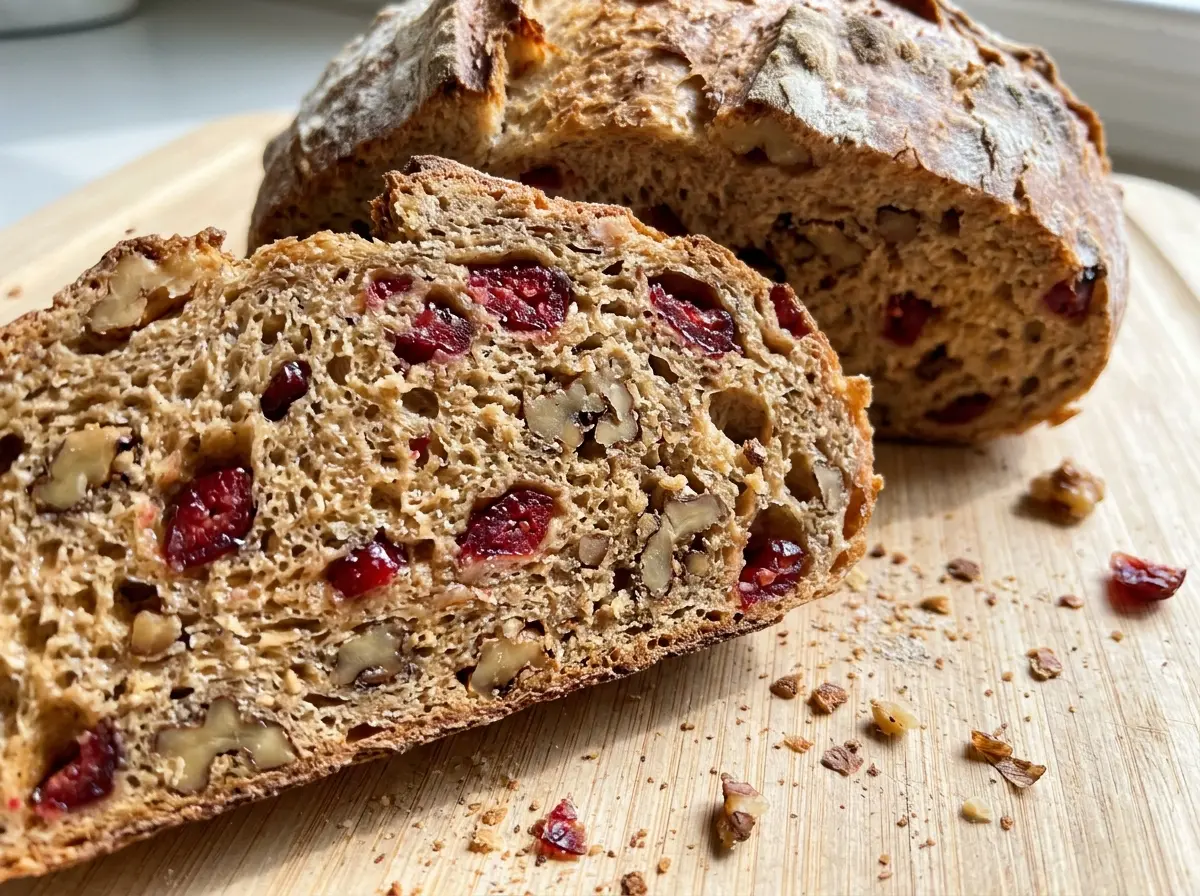
The cranberries are the first thing you notice when you slice into this loaf: bright, tart pockets set against a soft orange-scented crumb. The walnuts add a little crunch without taking over. Cranberry walnut bread can turn dense if the batter gets worked too much, so I keep the mixing gentle and stop as soon as the dry flour disappears.
Orange juice and finely grated zest give the loaf its citrus lift, while fresh cranberries bring enough sharpness to balance the sugar. Coarsely chopping the berries helps spread them through the batter, so you get fruit in every slice instead of a few oversized tart bites. The finished bread is tender, lightly sweet, and just as good with a plain cup of coffee as it is on its own.
Kitchen Note
Coarsely chopped cranberries give you little tart bursts throughout the loaf instead of whole berries that can take over a bite. I keep the pieces uneven but small enough to fold through the batter without crushing them.
Save this cranberry walnut bread for its tart cranberry pockets, crunchy walnuts, and fresh orange flavor.
Why Stirring Quick-Bread Batter Too Much Makes It Tough
Quick bread batter doesn’t need the long mixing that a yeast dough does. Once flour is stirred with liquid, gluten starts to develop; keep stirring past the point where the dry flour is gone and the loaf can bake up tight, chewy, or unevenly domed. Here, the wet mixture goes into the dry ingredients, and the stirring stops as soon as no dry flour remains.
A few small lumps are fine. Don’t try to smooth the batter until it looks silky, and don’t beat it to work out every streak. The cranberries and walnuts go in after the flour is incorporated, then get folded through with just enough turns to distribute them. That light touch leaves room for the baking powder and baking soda to lift the loaf instead of asking an overworked batter to rise.
The result should have a tender crumb that holds together when sliced, with fruit and nuts scattered through it. If you’re used to mixing cake batter until glossy, this is the moment to put the whisk down and switch to a spoon or spatula.
How Orange, Fresh Cranberries, and Walnuts Shape the Loaf

- Orange juice and zest — The juice brings moisture and a mild citrus tang; finely grated zest carries the stronger orange aroma. Fresh juice is lovely, but ordinary bottled orange juice works too. Grate only the colored outer peel, since the white pith underneath tastes bitter.
- Fresh cranberries — Their sharp flavor keeps the sweet loaf from tasting flat, and their moisture gives each bite a juicy pop. Choose firm berries without soft spots. There isn’t a close fresh-fruit substitute that keeps the same tartness and moisture balance, so dried cranberries will make a noticeably sweeter, drier loaf.
- Walnuts — Chopped walnuts bring a gentle bitterness and crisp texture that contrast with the soft crumb. A fresh bag is worth choosing here; old walnuts can taste stale or paint-like. For a nut-free loaf, leave them out rather than replacing them with another ingredient.
- Butter and egg — Melted butter gives the crumb richness, while the egg helps bind the loaf so it slices cleanly. Let the melted butter cool before whisking it with the egg; hot butter can start to set the egg in little flecks. Unsalted butter gives you the salt balance intended for the batter.
- Flour and leaveners — All-purpose flour provides the structure, and the baking powder and baking soda work together to lift the batter. Measure the flour without packing it into the cup; too much flour is one of the quickest ways to get a dry loaf. Keep both leaveners fresh for a reliable rise.
Mixing and Baking the Loaf Without a Tough Center
Get the Pan and Dry Ingredients Ready
Heat the oven to 350°F and grease a 9×5-inch loaf pan before you start mixing. Whisk the flour, sugar, baking powder, baking soda, and salt in a large bowl until the leaveners are spread evenly through the flour. This quick whisk helps prevent pockets of baking soda or baking powder in the finished bread. Set the bowl aside while you mix the wet ingredients.
Whisk the Orange Mixture
In a medium bowl, whisk the egg, orange juice, melted and cooled butter, and finely grated orange zest until they come together. The butter should be liquid but no longer hot. If it is still steaming, give it a little more time to cool before adding it to the egg. You want a uniform mixture, not a thick emulsion.
Bring the Batter Together Gently
Pour the wet mixture into the flour mixture and stir only until the last dry patches disappear. The batter will look thick and a little uneven; that’s preferable to mixing until smooth. Fold in the coarsely chopped cranberries and chopped walnuts with a few broad strokes, stopping once they are spread through the bowl. Scrape the batter into the greased pan.
Bake Until the Center Tests Clean
Bake for 55 to 65 minutes, until a toothpick inserted in the center comes out clean or with a few moist crumbs. Check the center rather than a spot close to the edge, which sets sooner. If the toothpick has wet batter clinging to it, the loaf needs more time; a couple of moist crumbs are the cue to stop. Cool the bread in the pan for 10 minutes, then turn it onto a wire rack and let it cool completely before slicing.
Two Simple Changes for a Different Cranberry Walnut Loaf
Make It Nut-Free
Leave out the walnuts for a nut-free loaf with a softer, more fruit-forward crumb. The recipe still bakes without another ingredient in their place; you’ll simply lose the crunchy contrast.
Make the Cranberry Pieces Smaller
Chop the fresh cranberries more finely than a coarse chop for smaller, more frequent tart notes in each slice. The fruit blends into the crumb more, so you get fewer distinct cranberry pockets and a more even distribution.
Storage and Reheating
- Refrigerator: Keep the cooled loaf airtight for up to 5 days. The crumb firms in the fridge; if you’ll finish it within 2 days, an airtight container at cool room temperature keeps it softer.
- Freezer: Freeze the completely cooled loaf whole or in slices, tightly wrapped, for up to 3 months. Thaw wrapped at room temperature to help the bread retain moisture.
- Reheating: Warm an individual slice in the microwave for about 10 seconds, then add a few seconds if needed. Longer heating can make the crumb rubbery.
Questions That Come Up Before Baking Cranberry Walnut Bread
Cranberry Walnut Bread
Ingredients
Equipment
Method
- Heat the oven to 350°F.
- Grease a 9x5-inch loaf pan.
- Whisk the flour, sugar, baking powder, baking soda, and salt in a large bowl.
- In a medium bowl, whisk the egg, orange juice, melted butter, and orange zest.
- Pour the wet mixture into the flour mixture and stir just until no dry flour remains.
- Fold in the cranberries and walnuts.
- Scrape the batter into the prepared pan.
- Bake for 55 to 65 minutes, until a toothpick inserted in the center comes out clean or with a few moist crumbs.
- Cool the bread in the pan for 10 minutes.
- Turn it out onto a wire rack.
- Cool completely before slicing.