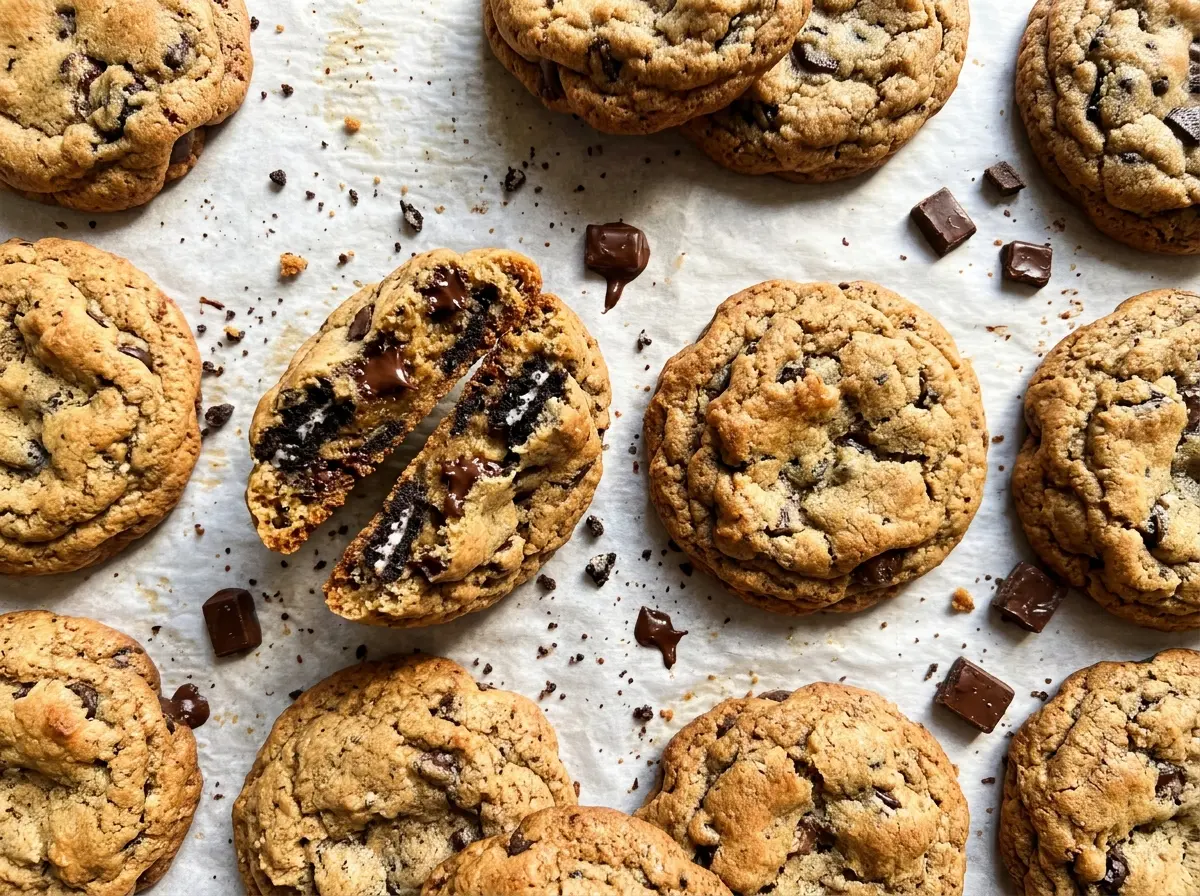
The chopped Oreos make the dough look almost too crowded when they first go in, but that’s exactly what I want: a chocolate chip cookie with little pockets of chocolate cookie and cream in every bite. These Oreo Chocolate Chip Cookies bake up with golden edges and centers that stay soft once they cool.
I cream softened butter with both sugars, then add the eggs one at a time before bringing in the flour. Folding the Oreos in at the end keeps those pieces recognizable instead of turning the whole bowl gray with crumbs. A short rest in the refrigerator firms the dough, which makes it easier to portion and helps the cookies hold their shape in the oven. The finished cookies are rich, chewy, and full of distinct Oreo pieces.
Kitchen Note
I pull the cookies when the edges are lightly golden and the centers look just set. Let them sit on the baking sheet for five minutes before moving them; that short pause gives the soft centers time to firm up without overbaking them.
Save these Oreo Chocolate Chip Cookies for a bake when you want soft centers, semisweet chocolate, and chunky Oreo pieces in every batch.
Why the Oreo Pieces Should Stay Bigger Than Crumbs
These cookies have two different kinds of chocolate, and the texture depends on letting each one do its own job. The chocolate chips melt into the dough as it bakes, while the Oreo pieces bring a separate cookie-and-cream bite. If the Oreos are crushed too finely, they blend into the dough instead of giving you those distinct pockets.
Coarse pieces also make the dough easier to portion evenly. Very large chunks can poke out of a scoop and leave one cookie loaded while another gets mostly dough, so aim for pieces that are easy to fold through the bowl. You don’t need every piece to be identical; a mix of smaller chunks and a few larger ones gives the cookies a nice variation from bite to bite.
The semisweet chips keep the overall sweetness from leaning too far toward the Oreo filling. Together, the two chocolates make a cookie that tastes familiar but has more going on than a standard chocolate chip batch. Keep the pieces distinct, and you’ll see that contrast in the finished cookie.
What the Butter, Sugars, and Cookies Bring to This Dough

- All-purpose flour — It gives the cookies enough structure to hold the chocolate and cookie pieces without turning cakey. A standard store-brand flour works well. For a nuttier, slightly denser cookie, replace half of it with the same amount of whole wheat pastry flour.
- Unsalted butter — Butter brings the rich flavor and helps the sugars cream into a smooth base. Store-brand butter is fine here; use it softened, not melted. If salted butter is what you have, use the same amount and leave out the added salt.
- Granulated and light brown sugars — The granulated sugar supports a lightly crisp edge, while brown sugar adds moisture and a gentle molasses note. Dark brown sugar can stand in for light brown at the same amount, though the cookies will have a deeper molasses flavor.
- Eggs — Large eggs at room temperature blend more evenly into the creamed butter and sugar. Fresh, ordinary grocery-store eggs work; a direct egg replacement won’t give this dough the same structure and richness.
- Vanilla extract — Vanilla rounds out the butter and chocolate, but there’s no need to buy an expensive bottle for baking. A standard pure or imitation vanilla works; the cookie’s main flavors still come from the chocolate and Oreos.
- Semisweet chocolate chips — Baking chips hold their shape as the cookies bake, giving you little pockets of chocolate. If you don’t have chips, use an equal volume of chopped semisweet baking chocolate; it will melt into more irregular pools.
- Oreo cookies — Use crisp cookies so their chocolate wafers and cream filling stay distinct in the dough. A fresh package from the grocery store is perfectly suitable; stale cookies are softer and lose some of their contrast.
From Creamed Butter to Set Centers: The Mixing Order
Whisk the Dry Ingredients Evenly
Whisk the flour, baking soda, and salt together in a medium bowl before they meet the wet ingredients. Break up any flour lumps and keep whisking until the small amount of baking soda looks evenly dispersed. This quick step helps the cookies bake consistently from edge to center. Set the bowl aside while you cream the butter and sugars.
Cream the Butter, Then Add the Eggs Gradually
Beat the softened butter with both sugars until creamy, about two minutes. The mixture should look blended and smooth rather than like separate butter pieces and sugar. Add the room-temperature eggs one at a time, beating after each addition, then mix in the vanilla. If the mixture looks a little loose after an egg goes in, keep beating until it comes together before adding the next one.
Fold in the Mix-Ins and Chill the Dough
Add the flour mixture and mix only until you no longer see dry streaks; stopping there keeps the cookies tender. Fold in the chocolate chips and coarsely chopped Oreos so they’re distributed throughout without crushing the cookie pieces. Cover the bowl and refrigerate the dough for 30 minutes. The chilled dough will feel firmer and be easier to scoop than it was straight from mixing.
Portion, Bake, and Let the Cookies Set
Heat the oven to 350°F and line two large baking sheets with parchment paper. Scoop the dough into 24 portions, about 2 1/2 tablespoons each, and leave at least 2 inches between them. Bake one sheet at a time on the center rack for 11 to 13 minutes, until the edges are lightly golden and the centers look just set. Cool the cookies on the baking sheet for five minutes, then transfer them to a wire rack to cool completely.
Three Smart Ways to Adapt Oreo Chocolate Chip Cookies
Make Them Gluten-Free
Replace the all-purpose flour with the same amount of a cup-for-cup gluten-free baking blend, and use 12 gluten-free chocolate sandwich cookies instead of Oreos. A blend that includes xanthan gum gives the dough better structure; the cookies may be a little more delicate, so let them cool fully before moving them.
Use Dark Chocolate Chips
Swap the semisweet chips for the same amount of dark chocolate chips. Their less-sweet, more intense flavor balances the Oreo filling, while the cookies keep the same soft centers and crisp edges.
Give Them a Mint-Chocolate Twist
Replace the Oreos with 12 mint chocolate sandwich cookies, keeping the chocolate chips semisweet. The mint comes through in the cookie pieces without changing the dough’s mixing or baking method.
Storage and Reheating
- Refrigerator: Store baked cookies in an airtight container for up to 5 days. The cold firms the centers and softens the Oreo pieces.
- Freezer: Freeze fully cooled cookies in an airtight container for up to 2 months, separating layers with parchment. Thaw at room temperature.
- Reheating: Warm one cookie in the microwave for about 8 seconds. Longer heating can make the chocolate too hot and the cookie pieces softer.
Questions That Come Up While Baking Oreo Chocolate Chip Cookies
Oreo Chocolate Chip Cookies
Ingredients
Equipment
Method
- Preheat the oven to 350°F.
- Line two large baking sheets with parchment paper.
- Whisk the flour, baking soda, and salt together in a medium bowl.
- Beat the butter, granulated sugar, and brown sugar in a large bowl until creamy, about 2 minutes.
- Beat in the eggs one at a time.
- Beat in the vanilla extract.
- Mix in the flour mixture just until combined.
- Fold in the chocolate chips and chopped Oreos.
- Cover and refrigerate the dough for 30 minutes.
- Scoop the dough into 24 portions, about 2 1/2 tablespoons each.
- Arrange the portions at least 2 inches apart on the prepared baking sheets.
- Bake one sheet at a time on the center rack for 11 to 13 minutes, until the edges are lightly golden and the centers look just set.
- Cool the cookies on the baking sheet for 5 minutes.
- Transfer the cookies to a wire rack to cool completely.